
Safe Tie Out for Multiple Dogs: 7 Systems
Table of Contents
- Why Safe Tie-Outs Matter for Multiple Dogs
- DOG SAFETY TRAVEL TIE-OUTS by dogsRtreed: Complete Gang Line System
- How to Prevent Dog Tie-Out Tangles: Setup and Spacing
- Building a Tangle-Free Dog Tie-Out System: Hardware Components
- DIY Dog Tie-Out Cable System: Custom Setup Options
- Weight Capacity and Breed-Specific Considerations
- Outdoor Durability: Weather Resistance and Maintenance
- Legal Compliance and HOA Restrictions for Tie-Outs
Why Safe Tie-Outs Matter for Multiple Dogs
Managing multiple dogs during travel, camping, or outdoor events creates real challenges. Without proper containment, dogs tangle around each other, wrap leads around trees and legs, and create chaos that puts their safety at risk. A safe tie-out for multiple dogs provides organized, secure positioning that keeps your pack controlled without constant supervision.
The difference between chaotic and well-designed systems comes down to hardware. Tangle-free technology relies on three core principles: spacing between dogs, 360-degree swivel mechanisms at connection points, and heavy-duty cable rated for combined pull force. dogsRtreed has spent decades refining gang line systems for hunters, mushers, and active dog owners. Their DOG SAFETY TRAVEL TIE-OUTS address the exact problems that plague generic setups: tangling, neck strain, and unpredictable failure.

DOG SAFETY TRAVEL TIE-OUTS by dogsRtreed: Complete Gang Line System
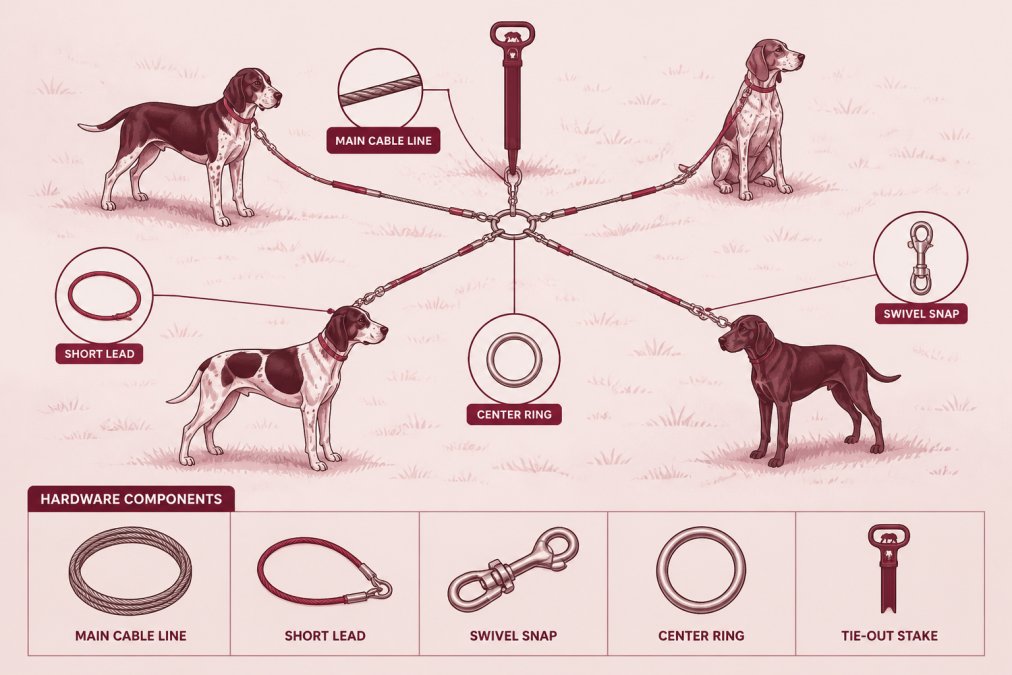
The DOG SAFETY TRAVEL TIE-OUTS system represents the professional standard for multi-dog containment. It comes fully assembled with all necessary short leads for your chosen capacity (2, 3, 4, 5, or 6 dogs), including the main cable line, individual short leads with snap hardware, and connection points rated for serious pull force.

The main cable is rated at 4700 lbs break strength, far beyond what even large dogs can achieve. The PVC coating protects against sharp wires and simplifies cleanup. Bright neon orange, burnt orange, or white coloring prevents tripping in low light.
Key Specifications and Pull Force Ratings
The main cable at 4700 lbs rated strength handles multiple dogs pulling simultaneously. Individual short leads are 22 inches long, providing movement without tangling. The system includes two heavy-duty spring snaps rated at 900 lbs working load, giving flexibility for staking to trees, ground anchors, or ratchet straps. Individual short leads connect at 5-foot intervals, the critical spacing that prevents dogs from reaching each other.
All attachment points use either Swedish spring snaps or solid brass bolt snaps. Spring snaps resist freezing in cold weather and offer proven durability. Brass bolt snaps provide corrosion resistance and smooth operation, ideal for marine or humid environments.
360-Degree Swivel Mechanism and Tangle Prevention
Every connection point features 360-degree swivel capability, preventing the most common failure: dogs spinning around the main line and wrapping leads around themselves. When a dog moves, the swivel rotates freely rather than allowing the lead to twist and bind.
Thimbles installed at every loop distribute stress evenly and allow full rotation without jamming. Combined with 5-foot spacing, this design makes tangling nearly impossible even when dogs are actively moving. Adhesive heat shrink on all crimps eliminates sharp edges that could cut hands or damage the PVC coating.
How to Prevent Dog Tie-Out Tangles: Setup and Spacing
Tangle prevention starts before attaching a single dog. Identify your anchor point and attach the main line's center ring directly to a tree trunk at ground level, or drive ground anchors in a straight line with the cable running between them. Never create a curved or angled main line, as this reduces swivel effectiveness.
The 5-foot spacing between dogs is non-negotiable. This distance ensures leads don't cross even when dogs move toward each other. Position larger, dominant dogs on the ends and smaller or calmer dogs in the middle. Before tethering, clear the area around each dog's position so leads hang freely without catching on obstacles.
Building a Tangle-Free Dog Tie-Out System: Hardware Components
A tangle-free system is only as good as its individual components. The main cable must be plastic-coated steel, not bare wire or chain. Bare wire frays and cuts; chain wraps around legs and necks, creating injury risk. Plastic coating provides smooth handling, visibility, and environmental protection.
Cable diameter matters. Use 3/16 inch or larger for multiple dogs. The plastic coating should be bright colored (neon orange, white, or burnt orange) for visibility in low light.
Swedish Spring Snaps vs. Brass Bolt Snaps
Swedish spring snaps use a spring-loaded mechanism that stays closed without additional securing. They're less likely to freeze in cold weather. The dogsRtreed DRT Swedish Spring Snap is rated for heavy-duty field use at $10.99 per snap, ideal for harsh conditions.
Brass bolt snaps use a sliding bolt mechanism and are quick to open and close. Solid brass resists corrosion in humid or salt-air environments. The dogsRtreed Solid Brass Bolt Snap costs $4.39 per snap but can freeze in extreme cold.
Many experienced handlers use a hybrid approach: a spring snap on the main line connection for security and a brass bolt snap for attaching individual dogs.
Swivel Mechanisms and Neck Strain Prevention
Every attachment point must include a swivel allowing 360-degree rotation without binding. A proper swivel should turn freely when manually rotated; resistance indicates damage or poor manufacturing that will jam under real-world conditions.
Neck strain occurs when leads twist and tighten around a dog's neck, restricting breathing and causing injury. Swivels prevent this by allowing the lead to rotate freely, dissipating twisting force. Thimbles installed at loop attachment points protect the cable from cutting into itself and provide the pivot point for swivel rotation. All thimbles should be solid metal.
DIY Dog Tie-Out Cable System: Custom Setup Options
Building your own system offers flexibility and cost savings but requires understanding critical components. A poorly assembled DIY system is worse than no system because it creates false confidence in a setup that could fail catastrophically.
Source plastic-coated steel cable rated for at least 3000 lbs break strength, 3/16 inch diameter or larger. For each dog position, you need a short lead (20-24 inches) with swivels at both ends. For the main line, use heavy-duty snaps rated for 500+ lbs working load. The assembly process requires crimping tools and proper crimp sleeves; improper crimps will slip under load.
Choosing Cable Length and Ground Anchoring
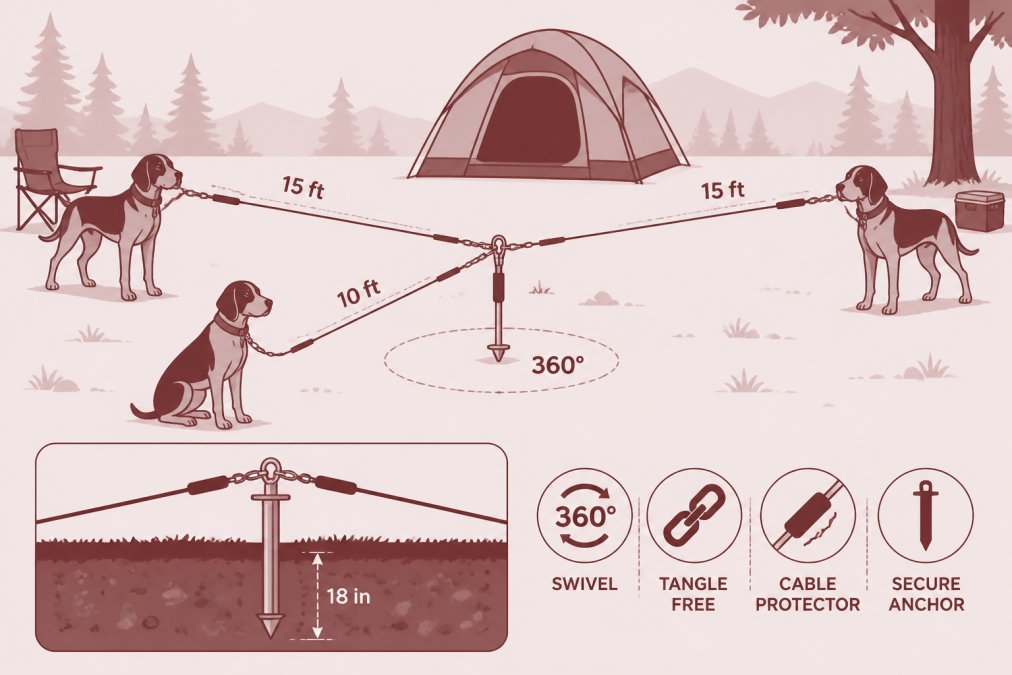
Cable length determines how much area your dogs can cover. For a 3-dog system, 25-30 feet is adequate, providing each dog roughly 8-10 feet of movement space. For a 5-dog system, 35-40 feet provides similar per-dog space.
Ground anchoring is where most DIY systems fail. The dogsRtreed TITAN TIE-OUT STAKE is purpose-built for this: a 24-inch solid steel stake with a 3/4-inch shank, barbed tip for ground grip, and 360-degree swivel sleeve with D-ring attachment at $46.99.

If using trees, wrap the main line around the trunk at least twice and secure with a carabiner or snap. For open ground, use at least two stakes driven perpendicular to the cable direction. In sandy or loose soil, stakes won't hold; you need deeper penetration or multiple anchors. In rocky soil, use trees or portable anchoring systems designed for hard ground.
Installation Steps and Safety Inspection Checklist
Lay out your main cable in a straight line between anchor points. Attach one end to an anchor with a snap rated for at least 500 lbs working load. Attach the other end to the second anchor. Position the center ring at the midpoint if using the dogsRtreed system.
Attach individual short leads at 5-foot intervals, perpendicular to the main cable. Before attaching dogs, perform a safety inspection:
| Inspection Item | What to Check | Pass Criteria |
|---|---|---|
| Cable condition | Plastic coating intact, no kinks or damage | No visible damage or sharp edges |
| Snap operation | Each snap opens and closes smoothly | Snaps lock securely without forcing |
| Swivel function | Each swivel rotates freely 360 degrees | No resistance or jamming |
| Anchor security | Stakes driven fully, carabiners secure | No movement when pulled firmly |
| Lead spacing | 5-foot intervals between dogs | Leads don't cross when dogs move |
| Cable tension | Main cable tight but not over-tensioned | Slight sag acceptable, no slack |
Attach dogs one at a time, starting with your calmest dog. Watch for unusual behavior or signs of stress.
Weight Capacity and Breed-Specific Considerations
The dogsRtreed main cable is rated at 4700 lbs break strength with a safe working load around 940 lbs, accommodating multiple large dogs pulling simultaneously. However, temperament matters more than weight. Anxious dogs that panic create sustained stress approaching working load limits, while calm, well-trained dogs create intermittent stress well within safe parameters.
Large breed dogs (over 80 pounds) should be spaced wider than 5 feet if possible. Small dogs (under 25 pounds) can be positioned closer but should be placed in the middle of the system, away from anchor points where tension is highest.
Sled dogs and high-drive working breeds understand tie-out systems and don't panic. Companion breeds may need gradual acclimation with short periods (15-30 minutes) initially.
Breeds with respiratory issues (bulldogs, pugs, Shih Tzus) require extra attention. Ensure swivels function perfectly and consider a wider collar or harness attachment instead of a neck collar to distribute pressure.
Outdoor Durability: Weather Resistance and Maintenance
The plastic PVC coating protects the underlying steel from rust and makes the cable easier to handle. However, exposure to UV light, temperature cycling, and physical abrasion gradually breaks down the coating. This is normal; the coating extends the cable's life but isn't permanent.
In salt-air areas, coating degrades faster. Rinse the system with fresh water after coastal use and allow it to dry completely. For systems stored outdoors, UV degradation is inevitable. The cable functions fine even without coating, though exposed cable is more prone to rust.
After each use, wipe down the cable with a cloth to remove dirt and debris. If used in mud, rinse with a hose and allow it to dry. Store the system loosely coiled in a dry location. Inspect monthly during heavy-use seasons, checking that all snaps operate smoothly and swivels rotate freely.
Legal Compliance and HOA Restrictions for Tie-Outs
Before installing a tie-out system, understand the legal landscape. Most states prohibit continuous outdoor tethering (24-hour confinement). The general standard is that tethering is acceptable for temporary containment during outdoor activities, camping, hunting, and travel events, but not as long-term housing. Duration limits vary by state, but 8-12 hours is typical.
Some states require specific equipment standards for tie-outs, typically including minimum cable diameter, weight capacity relative to dog weight, and swivel requirements. A properly functioning tie-out system with appropriate dog care meets all of them.
Homeowner Associations frequently have tethering restrictions in their bylaws. Check your HOA documentation before installing any system. Local animal control agencies sometimes enforce "humane tethering" standards specifying cable strength, swivel requirements, and shelter/water access. A properly functioning tie-out system with appropriate dog care meets all of them.
The key distinction is purpose. Tie-outs for temporary containment during travel and outdoor events are universally accepted. Tie-outs as permanent housing solutions face legal and ethical challenges.
A safe tie-out for multiple dogs transforms how you manage your pack during outdoor pursuits. The dogsRtreed DOG SAFETY TRAVEL TIE-OUTS system eliminates tangled leads and unreliable containment. With 4700 lbs cable strength, 360-degree swivels at every connection point, and 5-foot spacing between dogs, you get professional-grade reliability that works in real-world conditions. For hunters, mushers, and active dog owners who travel frequently, this is the system that delivers. Start with the complete gang line system at $66.99, and add the dogsRtreed TITAN TIE-OUT STAKE ($46.99) for ground anchoring that actually holds. Your dogs' safety depends on equipment that won't fail when it matters most.
Frequently Asked Questions
Can you put two dogs on one tie-out cable without them getting tangled?
Yes, with a proper tangle-free dog tie-out system. The key is using a gang line with individual short leads positioned on 5-foot centers, each with 360-degree swivels. This spacing prevents dogs from wrapping around each other. dogsRtreed's Safety Travel Tie-Out systems are designed specifically for this, with leads spaced far enough apart that adjacent dogs cannot tangle. Each lead connects via a swivel mechanism that rotates freely, eliminating the primary cause of entanglement.
What is the safest type of dog tie-out for multiple dogs?
A cable-based gang line system with individual tethers, swivel snaps, and proper spacing is the safest option. Look for systems with 4700 lb-rated cables, PVC coating for durability, and 360-degree swivel mechanisms on each lead. Heavy-duty hardware like Swedish spring snaps or brass bolt snaps prevents accidental release. Avoid chain, which can wrap around legs and cause injury. The DOG SAFETY TRAVEL TIE-OUTS by dogsRtreed feature all these safety elements and are specifically engineered for multi-dog containment during travel and outdoor activities.
How do I prevent my dogs from tangling on a tie-out system?
Proper setup is critical: install the main cable line with individual short leads positioned at least 5 feet apart. Use 360-degree swivels on every lead to allow full rotation without twisting. Ensure leads are 22 inches or longer to give each dog adequate movability. Position the tie-out away from obstacles like trees or brush where dogs might circle. Check regularly that leads haven't twisted during use. A tangle-free system like dogsRtreed's gang line minimizes tangles by design, but correct installation and spacing remain essential.
What weight capacity should I choose for my dogs?
Select a tie-out system rated for at least 1.5 times the combined weight of all dogs on the line. For example, three 40-pound dogs need a system rated for at least 180 pounds. Cable-based systems from dogsRtreed are rated at 4700 lbs, which handles virtually any dog pack. Consider your dogs' strength and pulling behavior, not just weight. Hunting and working dogs pull harder than casual pets, so choose heavier-duty hardware and higher-capacity systems if your dogs are strong pullers or if you have large breeds.
Can I use a DIY tie-out system, or should I buy a complete system?
Both work, but pre-manufactured systems offer proven engineering and safety testing that DIY setups may lack. If you build your own, use heavy-duty components: 4700 lb-rated cable, quality swivel snaps (Swedish spring or brass bolt), proper ground anchors like the TITAN TIE-OUT STAKE, and secure crimping with adhesive heat shrink to eliminate sharp edges. Pre-built systems like dogsRtreed's eliminate guesswork and come with all necessary hardware. For most owners managing multiple dogs, a complete system is safer, faster to set up, and more reliable during travel and outdoor events.
This article was written using GrandRanker