
How to Stop Dog Leash Tangling: 7 Proven Methods
Table of Contents
- Why Dog Leashes Get Tangled
- Best Tangle-Free Dog Leashes and Equipment
- Training Your Dog to Walk by Your Side
- Preventing Leash Tangles with Two Dogs
- Step-by-Step Untangling Techniques
- Dog Camping Safety Tips for Leash Management
- Choosing the Right Leash Length and Material
- Frequently Asked Questions
Last Updated: August 31, 2026
Why Dog Leashes Get Tangled
Dog leashes get tangled because dogs don't naturally understand how to walk in a straight line while tethered to a human. According to Sam Mountain, owner and professional dog trainer at Monkey Business Dog Training, "The leash is a human tool that dogs don't have any concept of when they come to us. Off-leash, they walk in a very different way, rather than in a straight line down a sidewalk tethered to a human. It's not natural to them at all. We need to teach them."
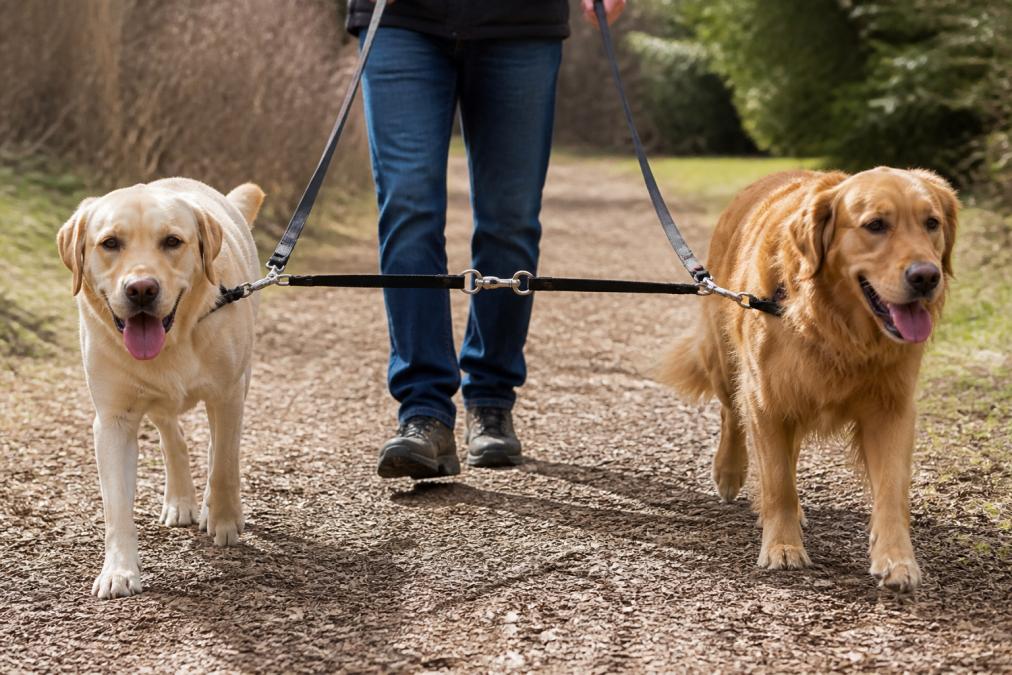
When your dog crosses paths with itself, circles around obstacles, or weaves between your legs, the leash wraps and tangles. Young dogs are particularly prone to this behavior, frequently pulling in unpredictable directions. Between 2001 and 2018, an estimated 356,746 dog leash-related injuries were treated at emergency departments, according to PubMed's American Journal of Emergency Medicine. Of these, 136,767 resulted from a trip or tangle. The injury rate per 1,000,000 population increased from 25.4 in 2001 to 105.5 in 2018, showing that leash-related accidents are becoming more common.
Most tangles happen because dogs haven't learned leash management. They don't understand that tension on the line means they've wrapped themselves. This is where training and equipment choices become critical.
Best Tangle-Free Dog Leashes and Equipment
Choosing the right leash and hardware makes a dramatic difference in preventing tangles. Cable leashes outperform traditional rope or nylon in tangle resistance. The rigid nature of cable prevents it from coiling on itself the way soft materials do. At dogsRtreed, we've engineered our LoopLESS Adjustable Cable Leash specifically to address the fixed-loop problem that frustrates many dog owners. At $22.99, this leash removes the traditional loop entirely, replacing it with an adjustable system that adapts to different collar types and attachment points.

The material matters more than most owners realize. Leather stretches and tangles easily. Nylon rope wraps around itself. Cable maintains its shape and resists knotting even when your dog circles repeatedly. Pauli et al. (2024) found in PMC research on leash equipment that intraocular pressure significantly increased in dogs when pulling on a neck collar but not on a harness, recommending harnesses for dogs with or at risk of eye disease.
Swivel Attachments and Couplers
A swivel attachment is the single most effective hardware upgrade for preventing tangles. The swivel allows the leash to rotate independently of the collar, eliminating the wrapping that occurs when your dog circles you.
The dogsRtreed 2-Dog Coupler with Swivel Bolt Snaps ($14.99) features a massive 1½-inch solid steel ring at the center, designed to handle tension without failure. The swivel mechanism rotates freely, preventing the leash from twisting into knots when dogs move in different directions. Pat Miller, Training Editor at Whole Dog Journal, notes that "It takes some skill to manage long and light lines without turning them into a knotted mess, but it's worth the effort." A quality swivel attachment reduces that skill requirement significantly.
When choosing a coupler, verify that the swivel rotates smoothly under tension. Test it by hand before purchasing, it should spin freely without resistance.
Front-Clip Harnesses
A front-clip harness redirects your dog's pulling toward their chest rather than their neck, which changes their walking mechanics and reduces the circular movements that cause tangles. Dogs wearing front-clip harnesses walk more predictably because the harness discourages lunging and side-to-side movement.
The front clip also provides better leash control without choking your dog. A comfortable dog walks more calmly, which naturally reduces entanglement.
Training Your Dog to Walk by Your Side
Equipment alone won't solve leash tangling. Your dog must learn that walking calmly beside you, without circling, crossing, or wrapping the leash, is the expected behavior. A dog that understands loose-leash walking fundamentals will tangle far less frequently.
The Stop and Wait Method
The stop and wait method teaches your dog that pulling or erratic movement stops forward progress entirely. When your dog pulls, crosses in front of you, or creates tension in the leash, you stop walking immediately. Stand still and wait without pulling back or correcting. Your dog will eventually slacken the leash. The instant the leash goes slack, resume walking and reward your dog with praise or a treat.
Monkey Business Dog Training uses this method. The key is consistency, every single time the dog pulls or wraps the leash, the handler stops. This method works because dogs are outcome-focused. They quickly learn that pulling creates the opposite of what they want (stopped progress), while walking calmly creates what they want (forward movement and rewards).
Loose-Leash Walking Fundamentals
Loose-leash walking means your dog walks at your side with 2-3 feet of slack in the leash. Start in a low-distraction environment like your backyard. Walk in a straight line and reward your dog every few steps for maintaining position at your side. Use high-value treats.
When your dog drifts away from the correct position, change direction. Don't call them back, simply turn and walk the opposite way. This teaches your dog to pay attention to your movement and maintain proximity without being told. The process takes consistent practice before loose-leash walking becomes automatic.
Preventing Leash Tangles with Two Dogs
Managing two dogs on leashes simultaneously creates exponentially more tangle opportunities. A multi-dog coupler solves the equipment side, while specific leash management practices address the technique side. leash pulling guide.
Using a Multi-Dog Coupler
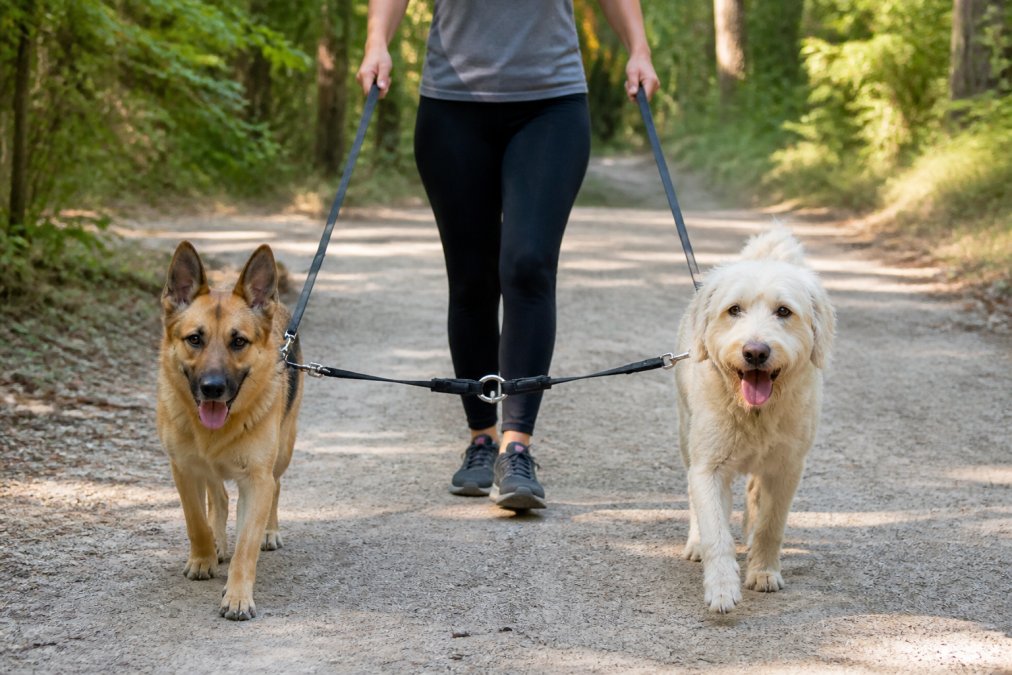
A multi-dog coupler connects two leashes to a single line, giving you one point of control instead of juggling two separate leashes. The dogsRtreed 2-Dog Coupler with Swivel Bolt Snaps ($14.99) uses a heavy-duty 1½-inch steel ring with swivel attachments on each side, allowing both dogs to move independently while the coupler prevents their leashes from tangling with each other.

The swivel mechanism is critical. Without it, when one dog circles, the coupler itself rotates and wraps the leashes together. With a quality swivel, the coupler spins freely, and each dog's leash remains separate. Verify that both attachment points are equally spaced from the center ring.
Managing Leash Tension with Multiple Dogs
Even with a coupler, leash management requires active attention. Keep both dogs at the same pace by adjusting your walking speed to match the slower dog. This prevents the faster dog from pulling ahead and creating the tension imbalance that causes tangles.
Walk in a straight line rather than weaving or turning frequently. When you must turn, do it slowly and deliberately, giving both dogs time to adjust their position. Never allow both dogs to sniff or investigate the same spot simultaneously. When one dog wants to stop, gently guide the other dog to continue forward.
Step-by-Step Untangling Techniques
Despite your best efforts, tangles will occasionally happen. Knowing how to untangle quickly and calmly prevents your dog from panicking and worsening the situation.
Quick Release Method
When your dog gets tangled, stop them from moving. Don't pull on the leash or try to force them backward, as this tightens the knot. Keep calm and speak in a soothing voice.
Trace the leash from the collar to the tangle point. Identify exactly where the wrapping occurs. Gently lift your dog's leg or body part away from the wrapped section. Move slowly and talk to your dog to keep them calm. Once you've created slack, carefully slide the leash loop off. If the tangle involves the collar itself, unclip the collar rather than fighting with the knot.
Preventing Wrapping During Walks
Watch for early signs of wrapping: when your dog circles, crosses behind you, or moves perpendicular to your direction. The moment you see these movements beginning, gently guide your dog back to your side. This interruption takes 5 seconds and prevents a full tangle.
Keep the leash at waist height with a slight bend in your elbow, allowing your dog to move naturally while maintaining control. Check your leash regularly for existing knots or twists. A leash that already has one knot is more prone to creating additional ones.
Dog Camping Safety Tips for Leash Management
Camping presents unique leash challenges because your dog is in an unfamiliar environment with new distractions. Use a tie-out system designed for camping rather than attempting to hold a leash for extended periods. This reduces tangle risk because your dog isn't constantly repositioning themselves relative to you.
Swivel attachments become even more critical in camping situations. Your dog will circle around trees, tents, and other camp objects. A swivel coupler or swivel clip allows these circles without the leash wrapping around obstacles.
Keep your dog's leash shorter at camp than during walks. A 6-foot leash gives you control without providing enough length for your dog to wrap around nearby objects. Before each camping trip, inspect your entire leash system for fraying, weak points, or existing damage.
Choosing the Right Leash Length and Material
The ideal leash length depends on your dog's training level and the environment. For dogs with solid loose-leash walking training, a 6-foot leash is optimal. For dogs still learning, a 4-foot leash gives you tighter control and reduces wrapping opportunities.
Longer leashes (15-20 feet) are useful for camping, hiking, and off-leash training, but they require significant skill to manage without tangling. If you're using a long line, practice with it in your yard before taking it into the field.
Material choice affects both tangle resistance and durability. Cable leashes resist tangling better than rope or nylon. Leather is attractive but tangles easily and requires maintenance. Biothane (synthetic leather) combines durability with some tangle resistance.
The global market for dog collars, leashes, and harnesses is expected to reach $6.8 billion in 2026, according to Persistence Market Research, driven by increased dog ownership and pet humanization. dogsRtreed's LoopLESS Adjustable Cable Leash ($22.99) combines cable durability with an adjustable attachment system, eliminating the fixed-loop problem that causes many tangles.
Dog leash tangling is preventable. The combination of proper equipment, consistent training, and active leash management eliminates the vast majority of tangle situations. Start with a quality coupler or swivel attachment, invest time in teaching your dog loose-leash walking, and stay alert during walks for early signs of wrapping. At dogsRtreed, we've designed our multi-dog couplers and adjustable cable leashes specifically for active dog owners who need reliable gear for camping, hunting, and travel. Our two-dog coupler with swivel attachments gives you the control you need while allowing your dogs the freedom to move naturally without tangling. Get started with dogsRtreed and experience walks where leash management becomes automatic, freeing you to focus on enjoying time with your dogs.
=== FAQ ANSWERS (audit these too, same rules) ===
[1] Q: How do I keep a two-dog leash from tangling? A: A multi-dog coupler with swivel attachments is the most effective solution for preventing tangles with two dogs. The coupler connects both dogs to a single leash while the swivel design allows each dog to move independently without the leash wrapping around them. Training both dogs to walk with loose-leash walking techniques and maintaining consistent leash slack also reduces tangling. The dogsRtreed 2-Dog Coupler with swivel bolt snaps ($14.99) is engineered specifically for this purpose, featuring a solid steel center ring that prevents knotting while keeping both dogs secure.
[2] Q: What is the best way to stop dog leash tangling during camping trips? A: When camping, use a tangle-free leash system designed for outdoor environments. Adjustable cable leashes with swivel attachments work well on uneven terrain, and front-clip harnesses reduce pulling that causes wrapping. Keep your leash length manageable for the space where you're camping, and practice loose-leash walking before your trip. The dogsRtreed LoopLESS Adjustable Cable Leash ($22.99) eliminates fixed-loop tangles common in traditional leashes, making it ideal for camping scenarios where terrain and obstacles change frequently.
[3] Q: Can training prevent my dog from tangling the leash? A: Yes. The 'stop and wait' method teaches dogs that pulling and wrapping the leash stops forward movement. When your dog creates tension or wraps the leash, stop walking immediately and wait for slack before resuming. This reinforces that loose-leash walking is rewarded with progress. Professional dog trainers recommend combining this with positive reinforcement, rewarding your dog with treats when the leash stays slack.
[4] Q: Are swivel leashes and couplers actually effective for preventing tangles? A: Yes, swivel attachments significantly reduce tangling. The swivel design allows the leash clip to rotate freely, preventing the leash from twisting and wrapping around your dog's legs or body. Research shows that dogs rated as better behaved during walks have lower leash tension overall, and proper equipment like swivel couplers supports this behavior. For multi-dog households, a coupler with swivel bolt snaps is one of the most effective tools available for managing multiple dogs without constant untangling.
Frequently Asked Questions
How do I keep a two-dog leash from tangling?
A multi-dog coupler with swivel attachments is the most effective solution for preventing tangles with two dogs. The coupler connects both dogs to a single leash while the swivel design allows each dog to move independently without the leash wrapping around them. Training both dogs to walk with loose-leash walking techniques and maintaining consistent leash slack also reduces tangling. The dogsRtreed 2-Dog Coupler with swivel bolt snaps ($14.99) is engineered specifically for this purpose, featuring a solid steel center ring that prevents knotting while keeping both dogs secure.
What is the best way to stop dog leash tangling during camping trips?
When camping, use a tangle-free leash system designed for outdoor environments. Adjustable cable leashes with swivel attachments work well on uneven terrain, and front-clip harnesses reduce pulling that causes wrapping. Keep your leash length manageable for the space where you're camping, and practice loose-leash walking before your trip. The dogsRtreed LoopLESS Adjustable Cable Leash ($22.99) eliminates fixed-loop tangles common in traditional leashes, making it ideal for camping scenarios where terrain and obstacles change frequently.
Can training prevent my dog from tangling the leash?
Yes. The 'stop and wait' method teaches dogs that pulling and wrapping the leash stops forward movement. When your dog creates tension or wraps the leash, stop walking immediately and wait for slack before resuming. This reinforces that loose-leash walking is rewarded with progress. Professional dog trainers recommend combining this with positive reinforcement, rewarding your dog with treats when the leash stays slack.
Are swivel leashes and couplers actually effective for preventing tangles?
Yes, swivel attachments significantly reduce tangling. The swivel design allows the leash clip to rotate freely, preventing the leash from twisting and wrapping around your dog's legs or body. Research shows that dogs rated as better behaved during walks have lower leash tension overall, and proper equipment like swivel couplers supports this behavior. For multi-dog households, a coupler with swivel bolt snaps is one of the most effective tools available for managing multiple dogs without constant untangling.
This article was written using GrandRanker